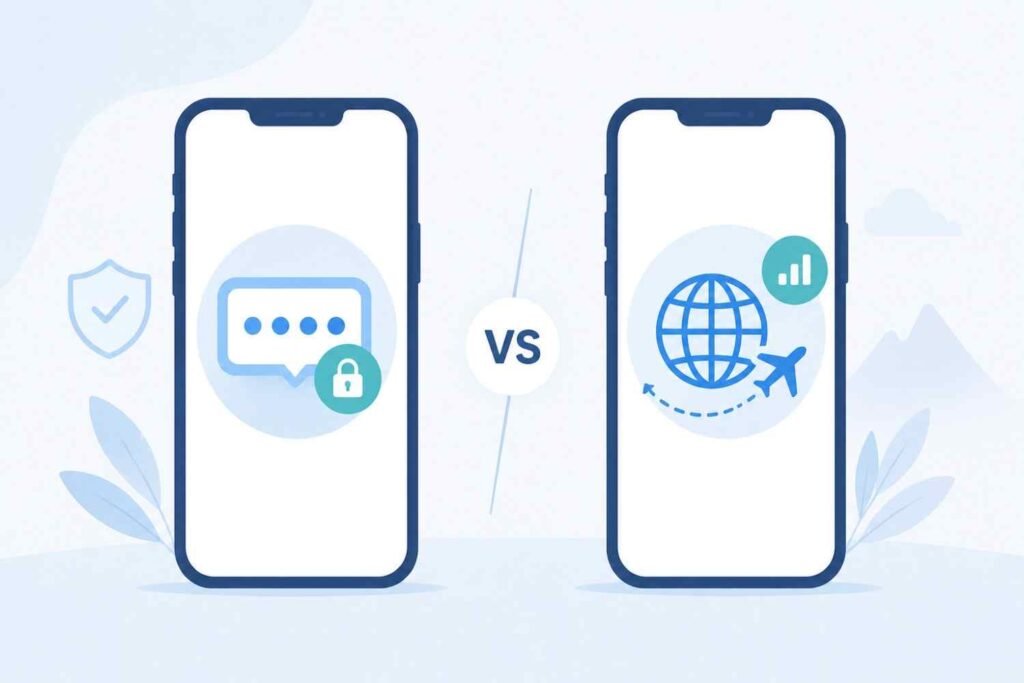
These two solve genuinely different problems, even though they’re often mentioned together in travel connectivity discussions. Understanding the distinction helps you figure out whether you need one, both, or neither.
What a Temporary Number Solves
A temporary virtual number gives you a phone number to receive calls or texts. It’s typically used for a short-term need — signing up for a local service, verifying an account, or giving out a number for a single form or listing without exposing your personal line.
It does not provide mobile data. Getting a temporary number by itself won’t get you internet access on your phone.
What an eSIM Solves
An eSIM gives you mobile data connectivity (and sometimes calls or SMS, depending on the plan) through a digital carrier profile. This lets you get online in a new country without a physical SIM card or roaming charges through your home carrier.
Getting a new phone number for others to reach you isn’t the primary purpose here, though some eSIM plans do include a number for calls and SMS as part of the package.
When You Need Just a Temporary Number
- You need to verify a local account or service while traveling, and your existing number already works for calls and data via roaming or Wi-Fi
- You’re filling out a form or listing that requires a number, without needing ongoing connectivity changes
When You Need Just an eSIM
- Your main concern is getting mobile data in a new country without expensive roaming charges
- You’re fine using your existing number for calls and texts via Wi-Fi calling or your home carrier’s roaming, so a new number isn’t needed
When You Need Both
Some situations call for both — say, you need US mobile data, and you also want a way to receive calls or texts on a US number specifically. Managing a US-based account that requires periodic SMS verification while also using data locally is a common example.
A provider offering both products lets you get everything from one place rather than combining two unrelated providers. eSIMFire sells a USA eSIM and a separate USA virtual number for exactly this situation. (Disclosure: eSIMOTP is operated by the same team as eSIMFire.)
A Quick Way to Decide
Ask yourself: “Do I need people to be able to reach me on a specific number, or do I need my phone to get online?” A number (temporary or long-term, depending on duration) is the answer to the first question. An eSIM answers the second. Both products make sense if the answer is genuinely “both.”
Frequently Asked Questions
Can an eSIM plan include a phone number too?
Some do, though many travel-focused eSIM plans are data-only. Check the specific plan’s inclusions before assuming a number is included.
Do I need a temporary number if I already have international roaming through my home carrier?
Not necessarily. If your existing number already works for calls and texts while traveling, a temporary number is only needed for specific local verification or listing purposes.
Is it more expensive to get both a temporary number and an eSIM separately?
This depends on the specific providers and plans. Some, like eSIMFire, offer both products, which may or may not be cheaper than combining two different providers, so it’s worth comparing directly.
Will a temporary number work for receiving SMS verification codes from US platforms?
Generally yes, assuming the platform accepts virtual numbers. Some platforms specifically screen for and block virtual number ranges regardless of provider.
Does using an eSIM change my existing phone number?
No. On most eSIM-compatible devices, the eSIM runs alongside your existing line, so your original number remains unaffected.